
Desaru’s Second Act
How Behaviour, Access, and Branding Are Repositioning the Coastline for the Singapore–Johor Era

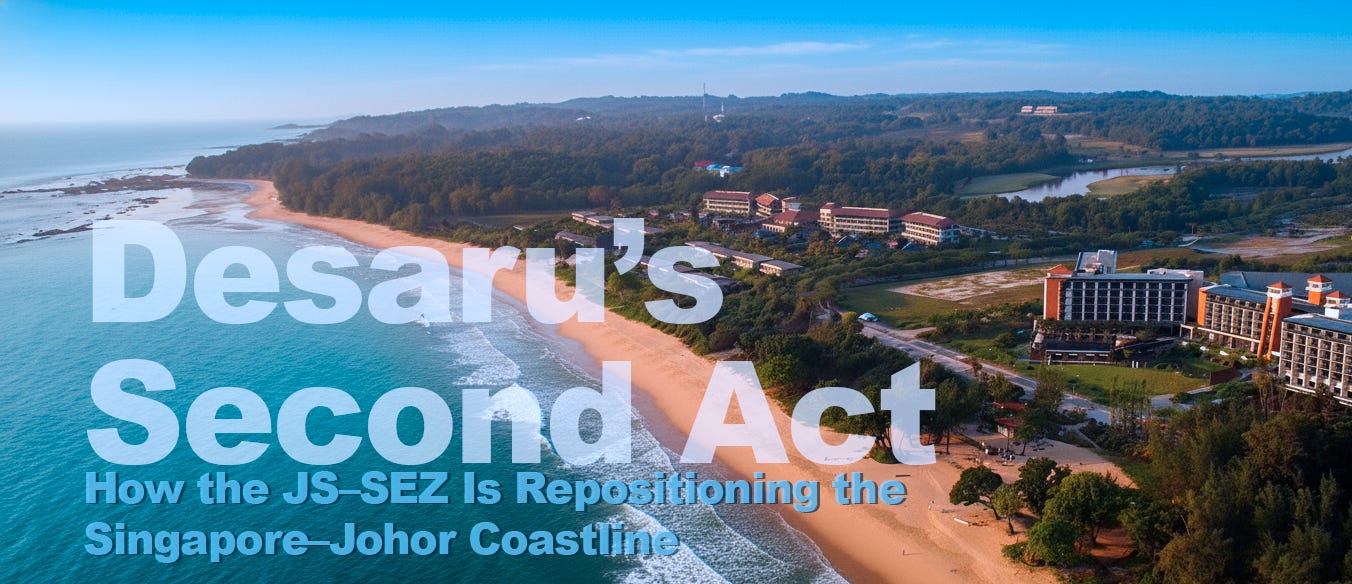
Desaru has always had the fundamentals: nearly 17 kilometres of uninterrupted coast, rainforest adjacency, and proximity to one of Asia’s deepest wealth basins across the causeway. Yet for years, it sat in an awkward category — pleasant, but occasional. Families visited, enjoyed it, and left, rarely returning with rhythm. The limitation was never demand. It was friction: travel uncertainty, weak night-time and social infrastructure, and a destination identity that never quite formed. That dynamic is now changing — not suddenly, but structurally.
Today, the landscape is shifting. While nothing is guaranteed, the conditions for a behavioural and capital inflection are forming.
From high promise to reset
Early momentum in Desaru was spearheaded by Khazanah Nasional’s push (via its subsidiary developer) to position the coastline as a regional resort hub. That vision included marquee resorts, championship golf and a water-park asset. However, follow-through faltered. Access remained challenging, the “trip” mindset prevailed rather than recurring visits, and the onset of Covid further disrupted rhythm.
Now, a fresh push is underway. Desaru is one of the flagship zones within the Johor‑Singapore Special Economic Zone (JS-SEZ), infrastructure momentum is building, and global resort operators are reaffirming commitment.
Infrastructure & psychological proximity: the unlock
A key catalyst is access. The current highway and ferry links support Desaru today, but both still carry high variability (weekend queues, unpredictable border delays, weather-sensitive marine services). The next phase of transformation centres on transport reliability and perception. With the nearby Johor Bahru–Singapore RTS Link ~75% complete and targeted for 2026-27, the psychological gap between Singapore and Johor continues to shrink. Once Johor becomes “almost next door,” Desaru moves from getaway to weekend base.
Parallel highway upgrades (notably the Senai–Desaru Expressway, SDE) will support this shift by reducing travel-time variance, fostering spontaneity and enabling repeated visits. Habit precedes investment; Belonging precedes capital allocation.
Opportunities in product evolution
The Experience Depth Gap
Infrastructure can make Desaru reachable, but it cannot make it habitual. The constraint has never been the coastline or the resort hardware — it is the depth of experience. Desaru still lacks the social and cultural fabric that turns a place from a getaway into a routine.
The water park is the clearest example. It launched with strong capital, brand visibility and early momentum, yet it never matured into the repeat-visit anchor it was designed to be. The concept was not flawed — the curation was. Desaru does see moments of cultural pulse, such as the Ombak Festival and Desaru Coast Bike Week, which both demonstrate the destination’s potential to draw regional audiences and create atmosphere. But these remain spikes, not a rhythm.
A lifestyle coastline needs cadence: seasonal event cycles, weekly dining and music activations, beach culture programming, informal night markets, and public-realm spaces where people linger. Hardware attracts the first visit; cadence earns the seventh. Today, Desaru has attractions — but they do not yet define the identity.
The Night-Time Economy Problem
This gap is most visible after dark. Once the sun sets, activity collapses back into hotel lounges and private dining rooms. A real weekend base needs places to wander and gather — waterfront walks, intimate lounge-style spaces with character, open-air dining clusters, live music terraces, late-evening cafés. Resorts create guests; streets create belonging. No coastal lifestyle market in the region has ever matured on resort compounds alone.
Latent Demand Next Door
The under-served demand is already next door. The Pengerang Integrated Complex employs over 4,000 permanent operational staff, and when long-term contractors, OEM specialists, turnaround teams and support services are included, the effective professional population is typically 9,000–12,000 people. Compensation levels in downstream petrochemicals are comparatively strong: RM6,000–10,000/month for mid-level local technical roles, with supervisory and expatriate packages significantly higher. This is a workforce with high work intensity and very limited leisure options in proximity.

As a result, many spend weekends in Johor Bahru or Singapore simply to decompress. Desaru is the nearest coastline with the physical potential to serve them — yet without a functioning night-time and social ecosystem, the catchment leaks outward rather than circulating locally.
The demand exists. What’s missing is a place to go , and reasons to return.
The Mandarin Oriental Signal
The upcoming rebrand of the former One&Only as Mandarin Oriental, Desaru Coast (expected January 2026) is therefore strategically meaningful. Mandarin Oriental does not enter speculative or untested lifestyle markets. It chooses locations where repeat visitation, pricing integrity and long-run guest loyalty are viable. Its footprint — on one of the quietest, lowest-density beachfronts in Desaru — re-anchors the coastline in a higher standard of luxury. When a top-tier operator arrives, the reference point for every supporting development rises: restaurants, beach clubs, branded residences, wellness retreats, marina concepts.
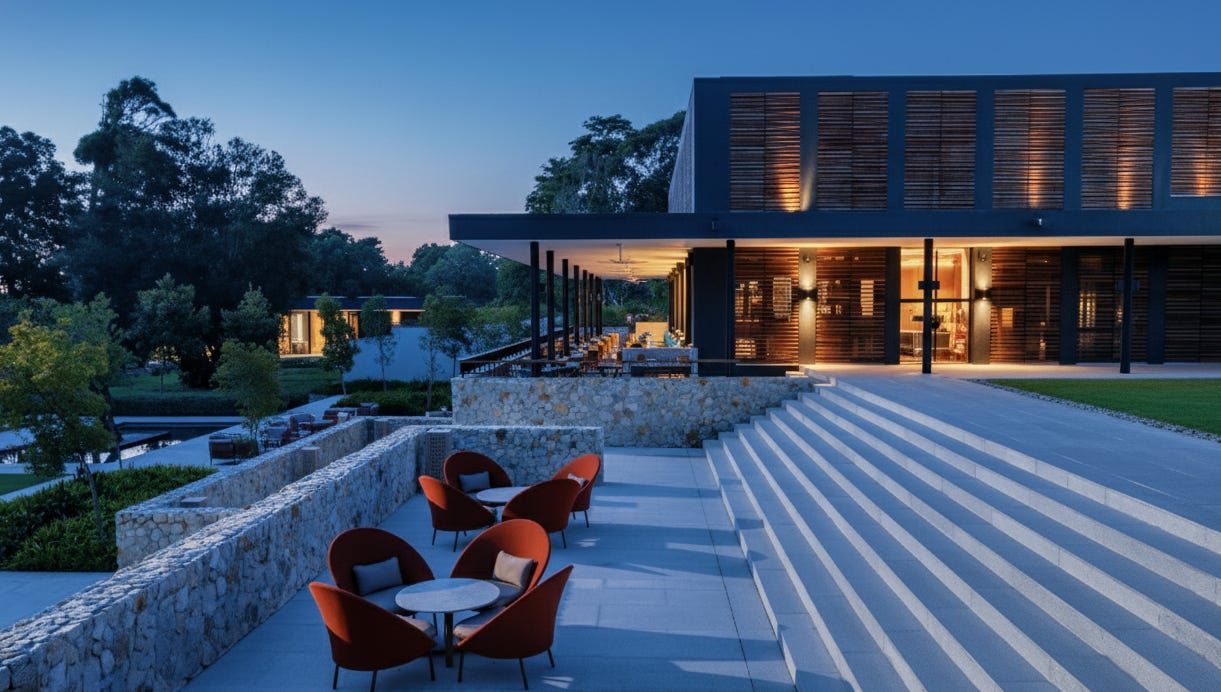
This is the institutionalization phase of a coastal destination:
A respected brand arrives.
Guests with higher expectations follow.
Repeat-stay patterns form.
Real estate shifts from discretionary holiday purchase to second-base-of-life logic.
Desaru is also differentiated among regional alternatives. Bintan remains close to Singapore but has not seen meaningful product renewal since its early resort era. Phuket and Bali have depth and identity but face overtourism, rising price floors, and shrinking privacy at the high end — eroding the sense of refuge that affluent travellers increasingly prioritise. Desaru, by contrast, sits before identity hardens, a phase where early operators shape culture, pricing power, and lifestyle norms.
This is the window where capital has leverage — before the behaviour pattern settles.
Incentives & investment rationale
On 1 January 2025, the JS-SEZ introduced a tax environment that materially changes the economics of operating in Johor. Eligible companies can access a 5% corporate tax rate for up to fifteen years, while approved knowledge professionals are able to pay a flat 15% personal income tax rate for a decade. In practical terms, this makes it easier to bring in and retain the kind of operating talent Desaru has historically struggled to hold: experienced resort managers, wellness practitioners, culinary teams, club operators, and programming curators.
For Desaru specifically, the relevant instrument is the Investment Tax Allowance (ITA) under Flagship G. To qualify, a development must commit at least RM500 million in capex (excluding land), include a hotel component with a minimum of 80 keys, and deliver at least one structured attraction — whether that takes the form of a recreation hub, marina base, convention experience, or equivalent.
When these conditions are met, the ITA allows 100% of qualifying capital expenditure to be set off against taxable income, up to seventy percent of each year’s statutory profit. It does not reduce the cost of building. It increases the return on holding, which is precisely where lifestyle destinations prove their value.
A further, often overlooked provision is the ability to expense hallmark events. This matters because programming — ongoing, seasonal, repeatable programming — is exactly what Desaru has lacked. The ability to justify, fund, and sustain a curated events calendar is not cosmetic; it is what turns a place from somewhere people visit into somewhere people return to without thinking.
The broader capital context is already shifting. By late 2025, roughly US$4 billion in Singapore-linked investment commitments had been announced in the JS-SEZ. The corridor is not a speculative idea. It is already a capital allocation zone, and Desaru sits inside it.
Incentives do not create demand, and they cannot rescue weak product. What they do is reward those who build for repeat presence vs. one-off visits. In that sense, the policy framework isn’t the thesis. It’s the accelerator for a thesis executed well.
What Could Go Wrong & Why It Still Matters
Execution risk remains high. Infrastructure timetables can slip (cross-border rail in SE Asia has a track record of delays). Competition abounds: Singaporean wealth can bypass Desaru for other escapes (Bintan, Phuket, Bali) if the value-proposition weakens. Seasonality and weather (monsoon wind-sea conditions) remain structural frictions for marine access and occupancy consistency. Demand segmentation needs clarity: the Singapore-wealth cohort is not monolithic—HNW families, empty-nesters, family offices each behave differently. The incentive regime helps economics but does not create the demand logic.
For developers, family offices or institutional investors looking for early-mover positions in lifestyle-corridor infrastructure, Desaru is worth watching. If you position while the habit-formation phase is underway, you benefit from the shift from planned-trip → weekend-base → belonging → residential logic. But the horizon is long (10-15 yrs), the product must be right, and the execution must align.
With the recent resort operator change (Mandarin Oriental takeover), JS-SEZ momentum and infrastructure upgrades in motion, Desaru is not just an interesting resort story, it is becoming an investable lifestyle-corridor play.
Conclusion
Desaru is not yet the lifestyle anchor of the Singapore–Johor wealth corridor, but the conditions required for that outcome are now taking shape. Access is steadily improving. Visitor familiarity will increase once the RTS normalizes weekend cross-border movement. Another global brand has taken a long-term position on the coastline. And policy incentives now favour projects built for recurring use rather than transient tourism.
The pivot that matters is not the number of new rooms built, but whether Desaru becomes part of people’s weekly and monthly rhythm. When that happens, real estate stops being a discretionary holiday purchase and starts becoming a second base of life — and that is when value compounds.
This is a market that rewards those who move before behaviour shifts — not after.
The question is no longer whether Desaru will change.
The question is who will shape the version that endures.
Nasser Ismail
Founder, JS-SEZ Monitor
Former IRDA (Founding Team) · Former PTP Free Zone Leadership
Clear-eyed commentary on the Johor–Singapore SEZ — without the corporate spin, ministry optimism, or developer gloss.
Just the structural incentives, the policy logic, and what they mean for capital and outcomes.
Subscribe if you prefer uncomfortable clarity over comforting narratives.