
The 2 a.m. Problem
Johor's data centre boom has a clean energy gap nobody is talking about

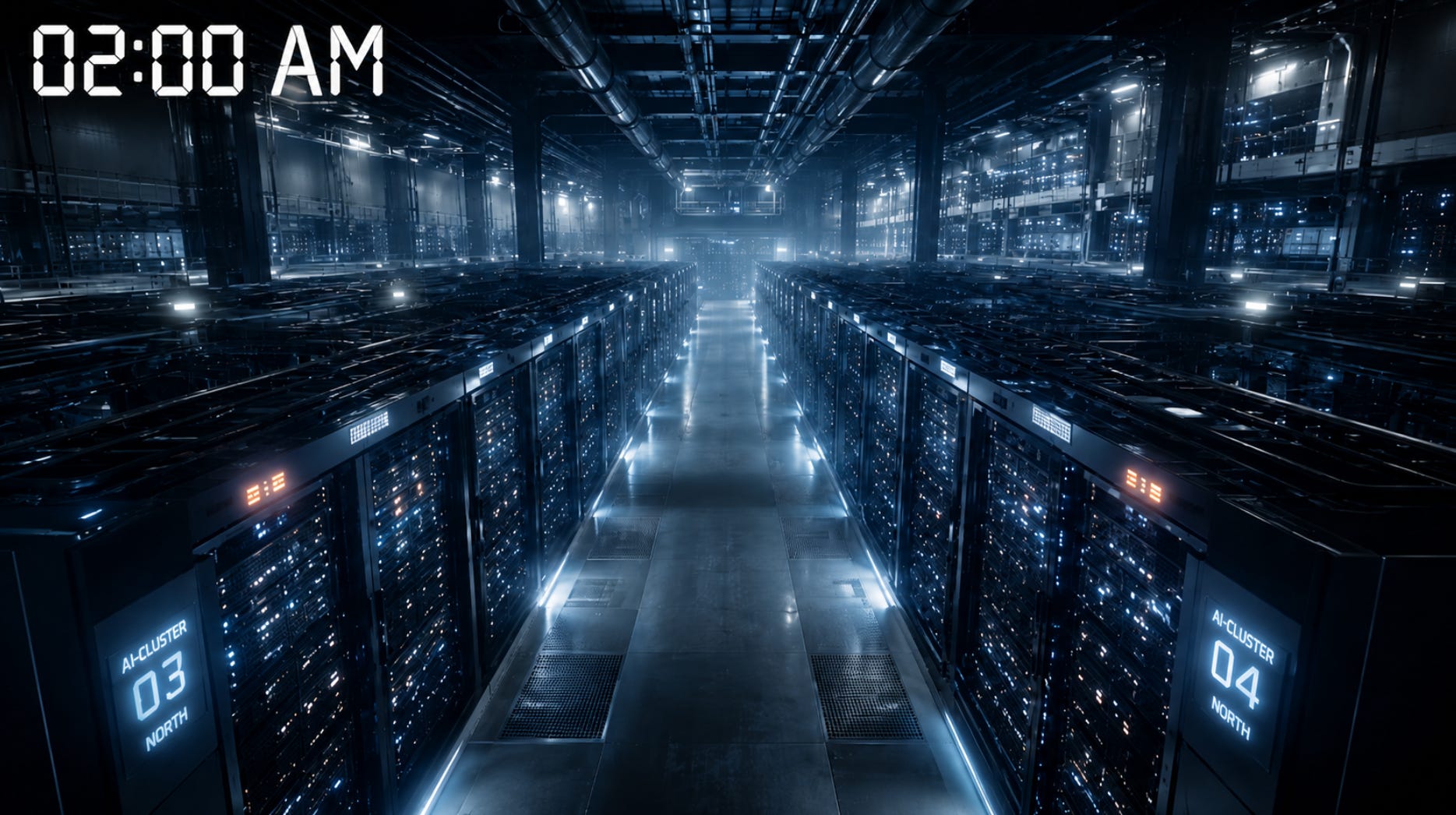
The Johor-Singapore Special Economic Zone (JS-SEZ) is currently experiencing an unprecedented influx of hyperscale data centre investments. With Malaysia’s data-centre electricity demand officially projected to reach 7.7GW by 2030, and Johor carrying a disproportionate share of that load, the state is becoming one of the critical compute nodes in Southeast Asia.
But beneath the surface of these multi-billion-ringgit announcements lies a more complex structural bottleneck. The first wave of the data-centre boom was about land, water, grid connection, and proximity to Singapore. The second wave will be about something less visible but potentially more decisive: the ability to prove, hour by hour, that the electricity consumed by AI infrastructure is matched by credible, deliverable clean energy.
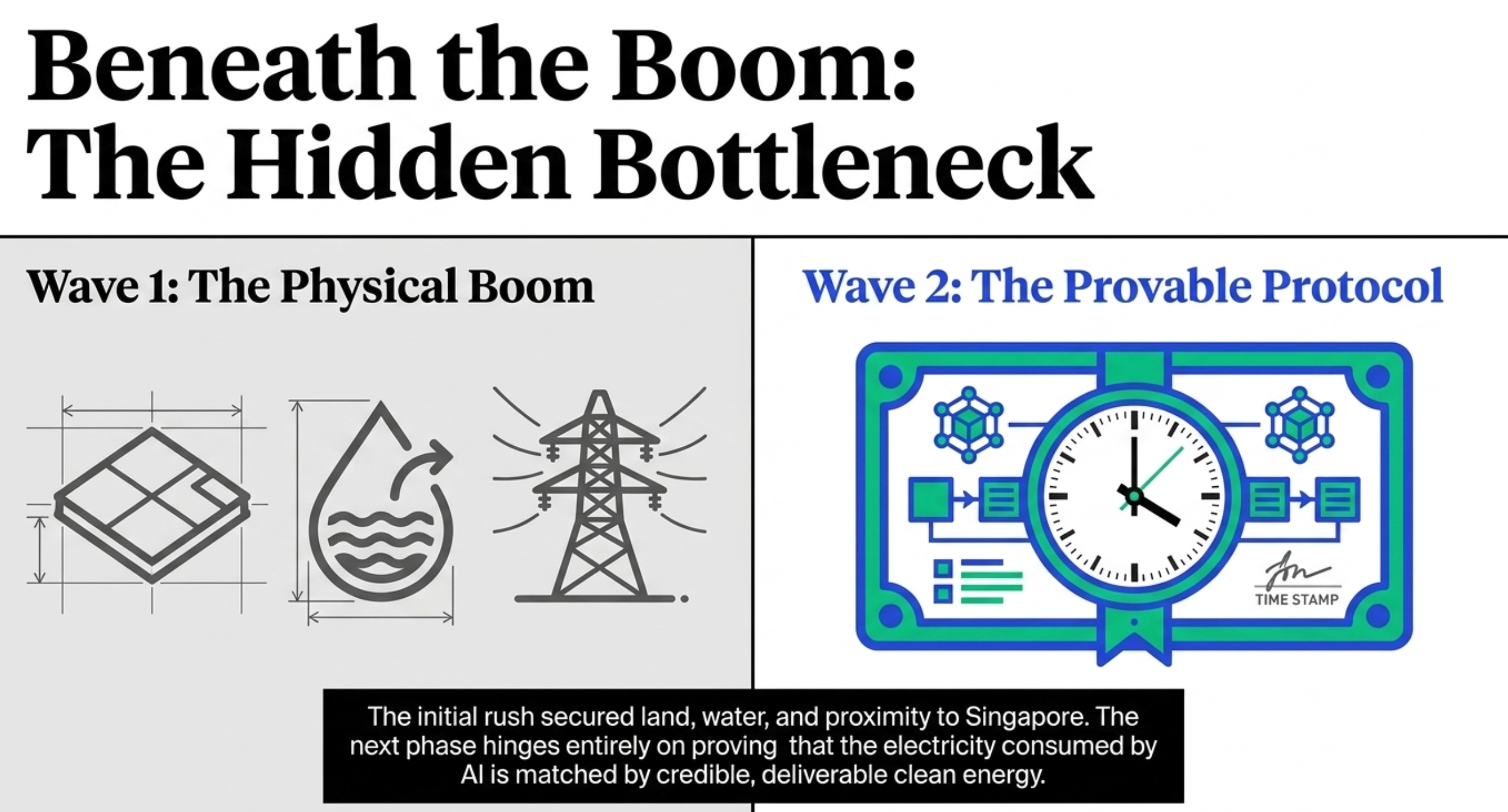
In other words, Johor’s next competitive frontier is not simply the physical megawatt. It is the verified green megawatt.
The Compute Profile: Why AI Breaks Old Models
To understand the urgency of this shift, one must look at the load profile of the modern AI data centre. Traditional enterprise cloud workloads had more natural variation, loosely following business demand, consumer activity, and regional traffic patterns. AI data centres behave quite differently.
Training clusters for developing the AI models are designed to keep expensive GPU capacity highly utilised for long periods, while inference which is what happens when you type in prompts to your AI chatbot, creates continuous, latency-sensitive demand. High-performance GPU and AI accelerator clusters, from Nvidia Blackwell-class systems to custom hyperscale silicon, do not behave like ordinary enterprise servers. They turn electricity into compute on a near-industrial basis.
This creates a new kind of baseload: not steel, chemicals, or aluminium, but machine intelligence. And that baseload has to be powered not just reliably, but credibly.
The Evolution of the “Green” Claim
For years, the corporate standard for sustainability was “100% Renewable Energy.” This was largely achieved through annual matching. A data centre could consume fossil-fuel-heavy grid power at night, buy unbundled solar Renewable Energy Certificates (RECs) generated during the day, and balance their ledger at the end of the year to claim carbon neutrality.
That era is ending.
Driven by stringent ESG mandates, the market is shifting from annual RECs to high-resolution Granular Certificates (GCs). Google and Microsoft have already made explicit 24/7 or hourly zero-carbon commitments, while Amazon/AWS and other hyperscalers are moving under rising customer, investor, and regulatory pressure toward more rigorous carbon-free procurement.
The Geographical Reality and the Storage Penalty
For the JS-SEZ, the global shift to 24/7 clean energy creates a problem that is as much about geography as energy.
Malaysia owns one of the region’s best clean energy assets for this challenge: Sarawak’s hydropower. Hydropower runs continuously. Solar farms stop when the sun sets. Wind depends on the weather. Hydropower, with water held in reservoirs and released through turbines on demand, generates clean electricity at three in the afternoon or three in the morning with equal reliability. For data centres that never sleep, this is the kind of clean power that matters.
The problem is that this ideal asset sits on the wrong side of the country.
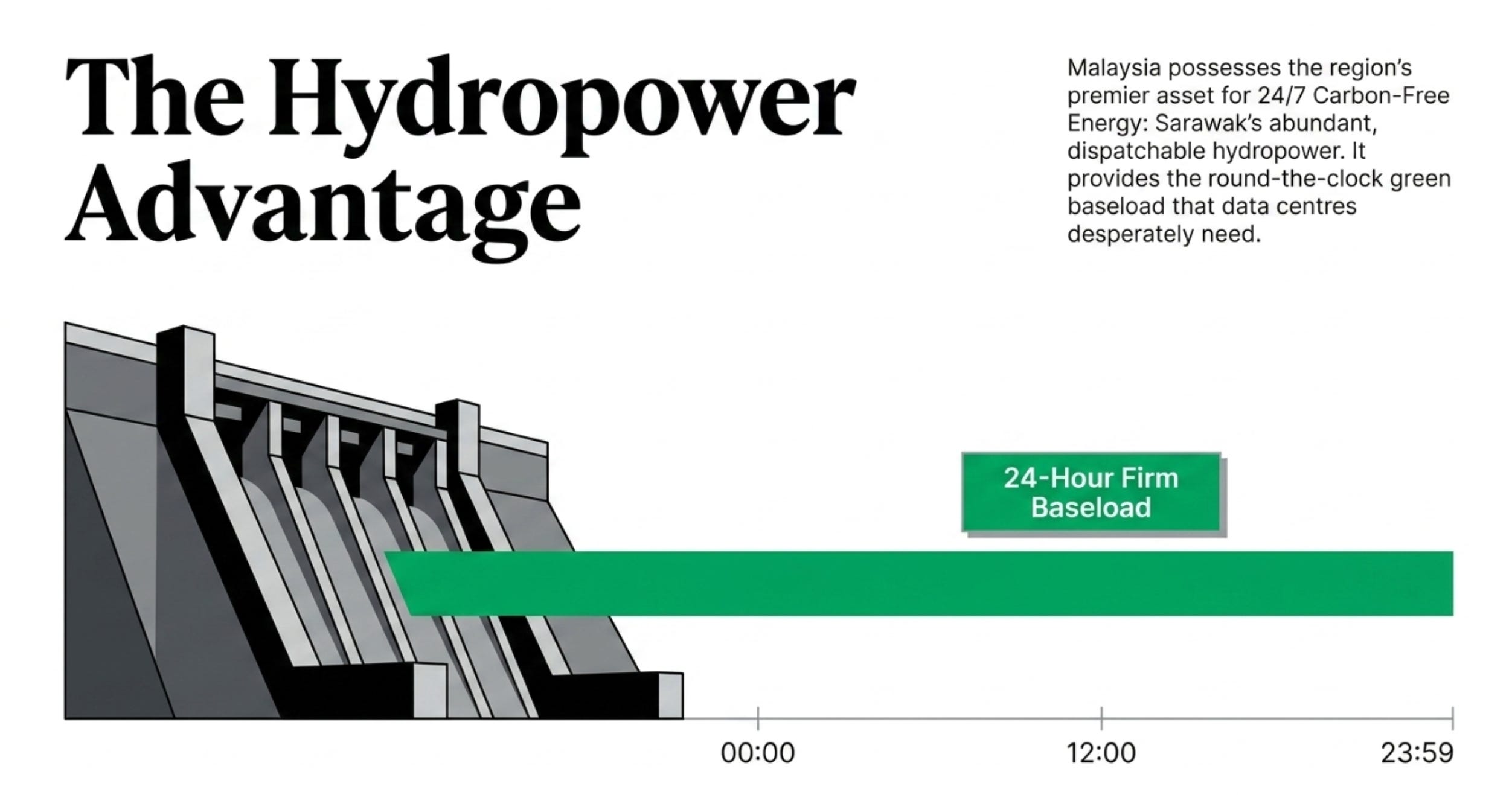
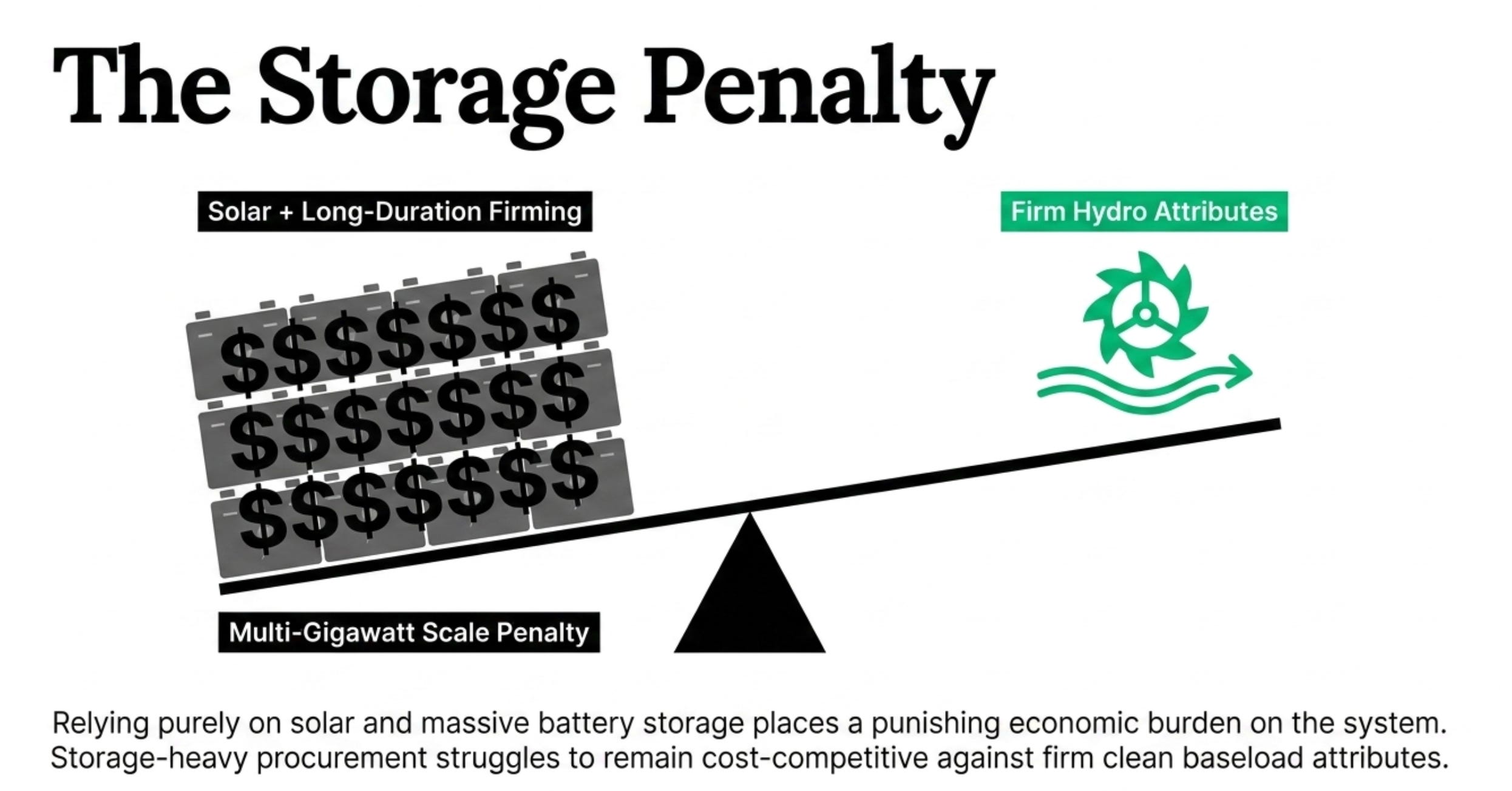
If Johor cannot tap into Sarawak’s hydro credentials, the alternative becomes expensive. Powering gigawatt-scale data centres on solar means building enormous battery systems to store daytime sunshine for nighttime use. Batteries help, but at this scale the cost of covering every nighttime hour becomes a serious commercial burden. Sarawak hydro, simply by being available around the clock, sidesteps that cost.
The new global rules on what counts as credible clean energy are also becoming stricter about geography. A buyer can no longer purchase a clean energy certificate from anywhere in the world and call their electricity green. The clean generation must be plausibly connected to where the electricity is consumed, through the same grid or a genuine physical link. This “deliverability” requirement is becoming the global standard for serious 24/7 clean energy claims.
This is where Johor’s geographic problem becomes acute. Peninsular Malaysia, where Johor sits, runs on one grid. Sarawak runs on a completely separate grid, on the other side of the South China Sea. There is no physical connection between them. Under the emerging international standards, a Johor data centre cannot straightforwardly claim that its electricity is backed by Sarawak hydropower, because Sarawak’s clean electrons cannot physically reach Peninsular Malaysia.
Unless Malaysia builds a credible way to bridge this gap, with certification architecture sophisticated enough to satisfy international auditors that Sarawak’s clean attributes can legitimately back Peninsular consumption, Johor risks being locked out of the premium green data centre market, even as the clean energy it needs sits abundantly available a few hundred kilometres away.
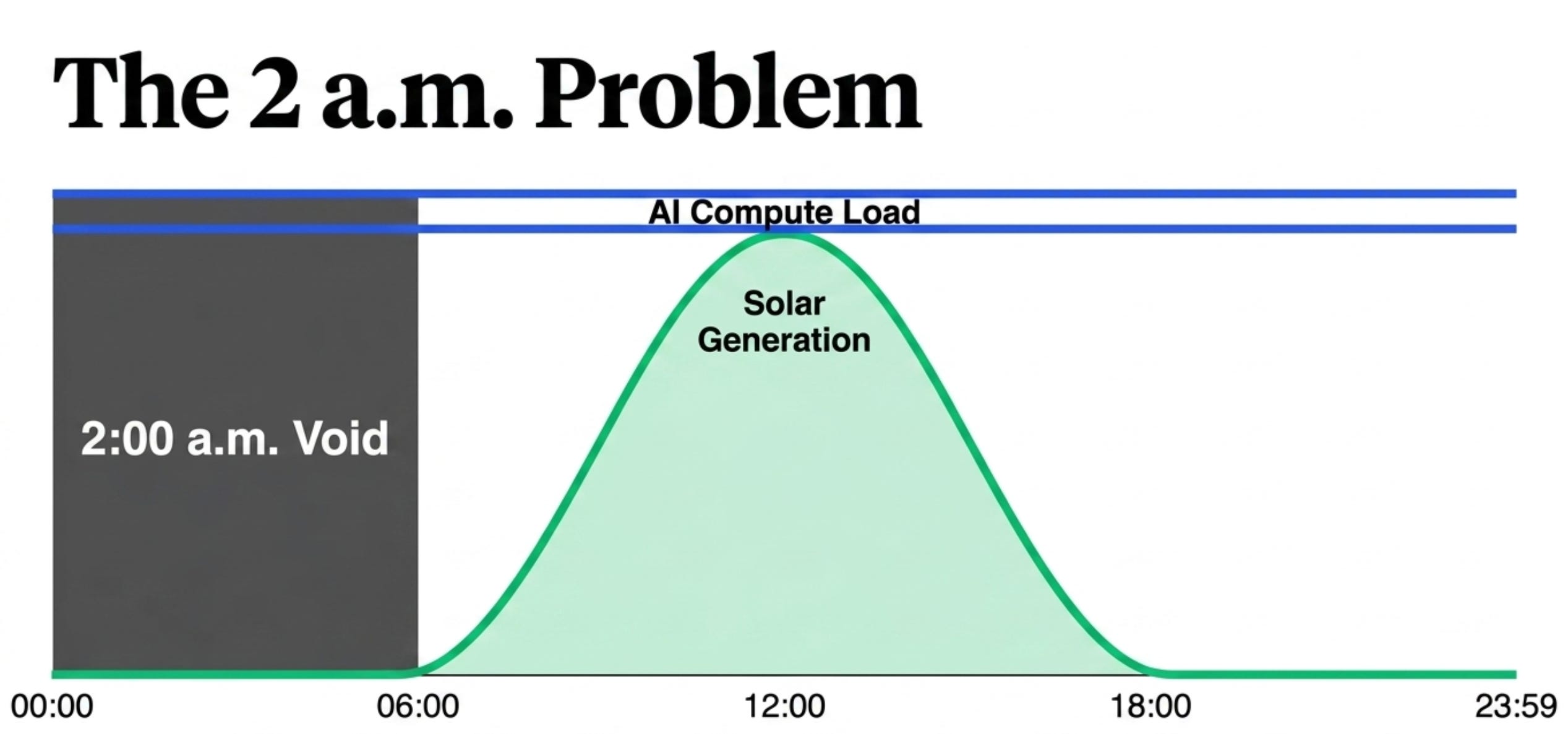
The Missing Layer: The 2 a.m. Problem
Malaysia has already begun building the first layer of this market through the Corporate Renewable Energy Supply Scheme (CRESS) and corporate renewable procurement. That matters.
But solar-heavy procurement solves only part of the hyperscaler equation. It can reduce annual Scope 2 exposure and cover daytime load, but it does not by itself answer the harder question: what clean attribute backs a Johor AI cluster at 2 a.m.?
The Market Infrastructure
Bridging this geographical divide will require sophisticated market mechanisms. Currently, the Malaysian market relies on established annual Renewable Energy Certificates (RECs) to meet corporate sustainability targets. Institutions like Bursa Carbon Exchange (BCX) have successfully built the trading infrastructure to facilitate these foundational instruments.
However, as international hyperscalers push for sub-hourly matching to hit their 24/7 CFE targets, the broader Southeast Asian region will need to decide how to upgrade its digital accounting architecture. Whether this takes the form of new cross-border frameworks, upgraded national grid policies, or localized granular tracking, the market is currently waiting for a clear demand signal to justify the infrastructure build-out.
The Strategic Horizon: The Race for the ASEAN Grid
The Sarawak-Singapore interconnector has moved from concept to conditional approval. Singapore’s Energy Market Authority (EMA) has already granted conditional approval for 1GW of low-carbon electricity imports from Sarawak, with commercial operations anticipated around 2035. However, it is not an immediate solution for Johor. Its initial market design is aimed at Singapore, not Peninsular Malaysia’s data-centre load.
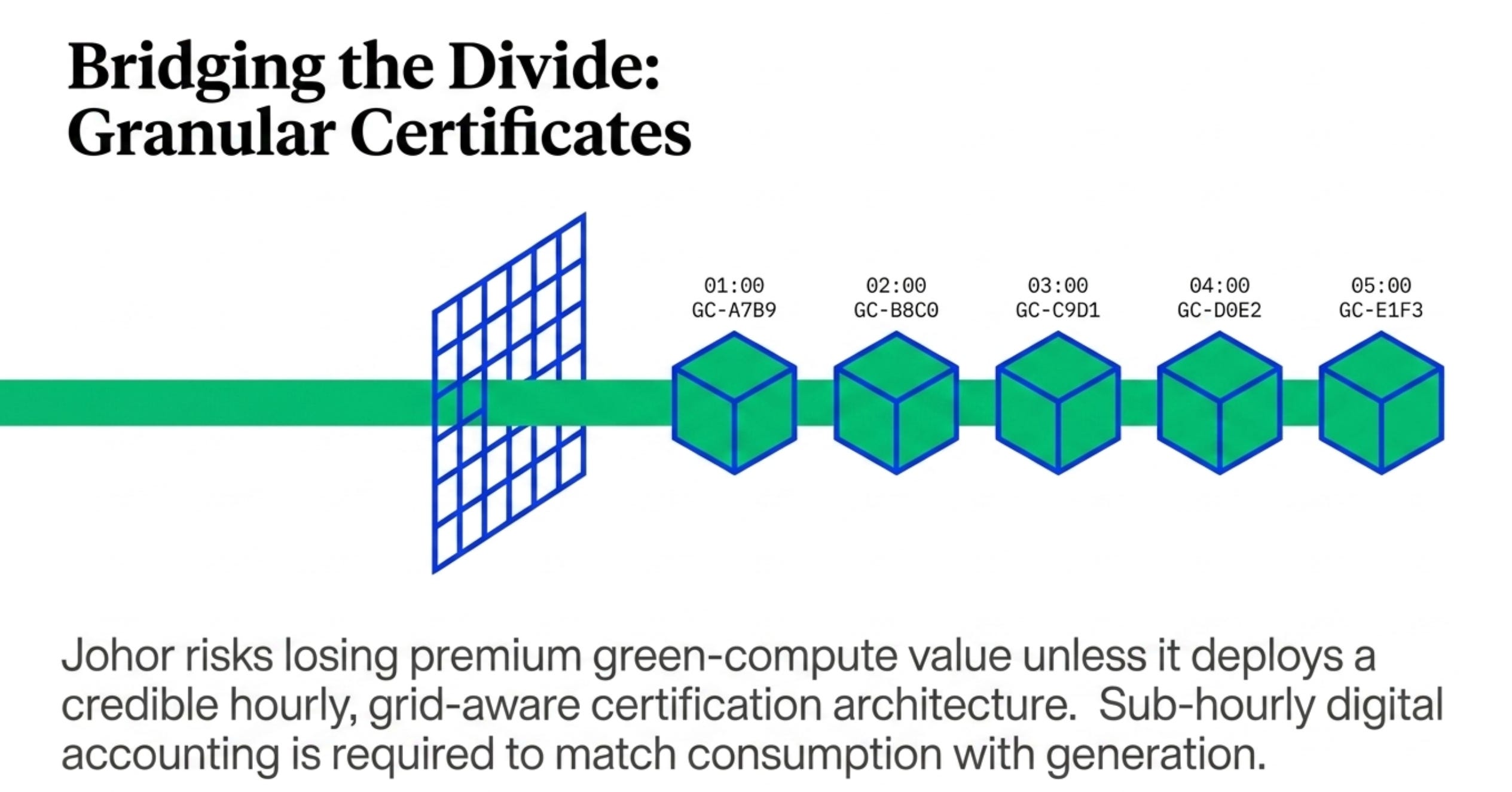
Johor may be geographically closer to Singapore, but without advanced cross-border accounting frameworks, it remains structurally farther from Sarawak’s clean baseload. To retain these high-value tenants and attract the next generation of green industrial investments, the region’s clean energy accounting must become as sophisticated as its engineering. The physical megawatt is only half the equation; the digital protocol that proves its provenance will dictate who captures the premium value of the green economy.
Nasser Ismail
Founder, JS-SEZ Monitor
Former IRDA (Founding Team) · Former PTP Free Zone Leadership
Clear-eyed commentary on the Johor–Singapore SEZ without the corporate spin, ministry optimism, or developer gloss. Just the structural incentives, the policy logic, and what they mean for capital and outcomes.
Subscribe if you prefer uncomfortable clarity over comforting narratives.
I shared some of my thoughts with CNA https://www.channelnewsasia.com/asia/malaysia-johor-transport-woes-art-lrt-congestion-6164086